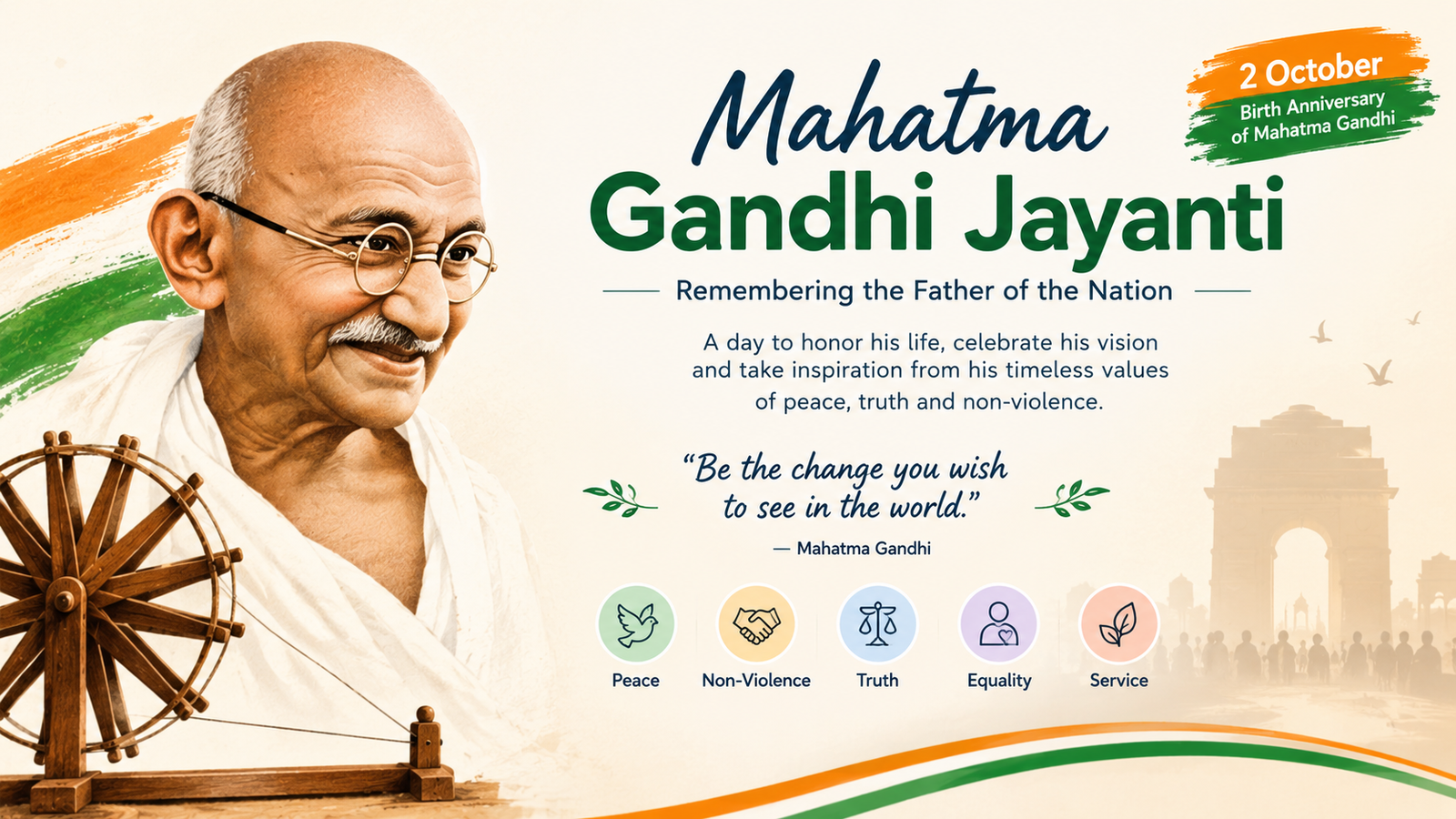
Mahatma Gandhi Jayanti is observed every year on 2 October to remember the birth anniversary of Mohandas Karamchand Gandhi. He was born in Porbandar in 1869. The day is remembered in India through tributes, educational activities, prayer meetings and programmes that discuss values such as truth and non-violence. Mahatma Gandhi Jayanti is also connected with the United Nations International Day of Non-Violence, which is observed on the same date.
What Is Mahatma Gandhi Jayanti?
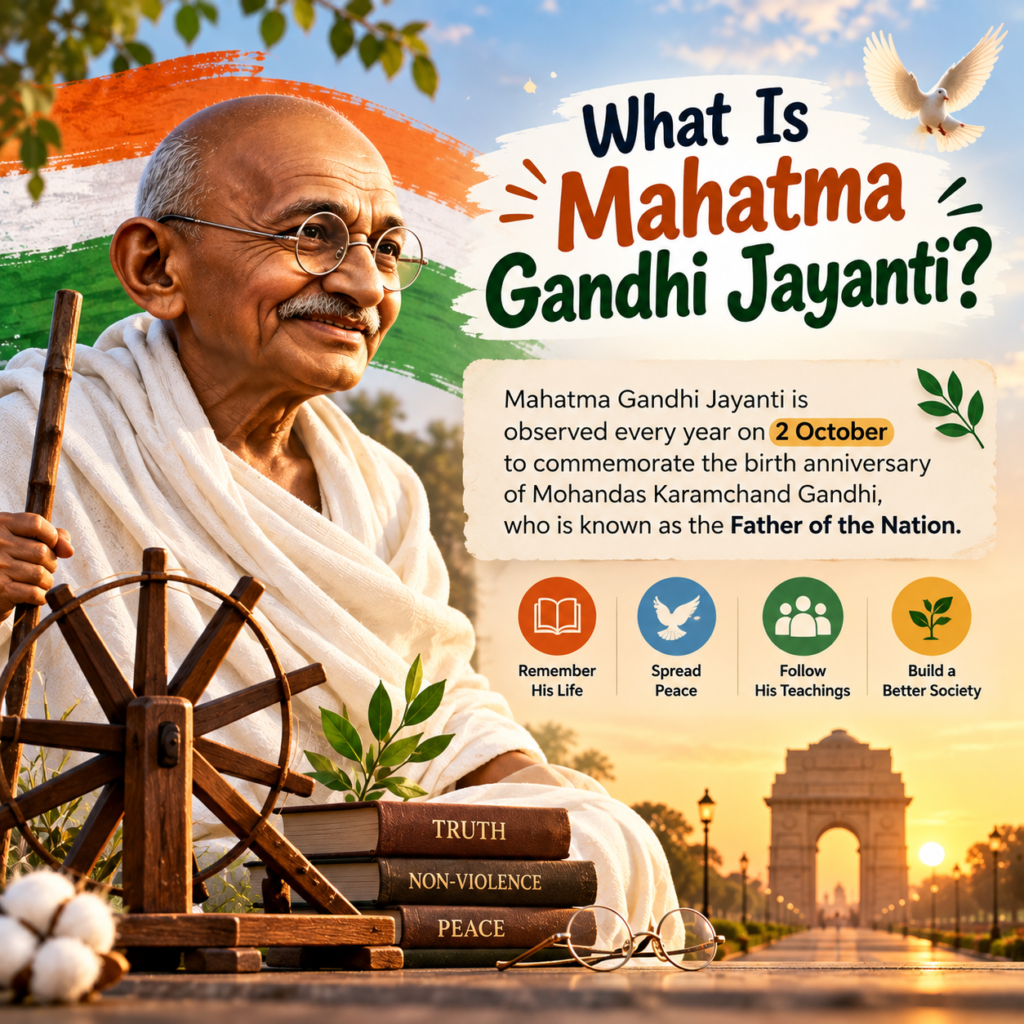
Mahatma Gandhi Jayanti marks the birth anniversary of Mahatma Gandhi. The Gandhi Heritage Portal records his birth on 2 October 1869 in Porbandar. Over the years, this date has become an occasion to learn about his life, public work and ideas.
The occasion is not only about remembering a historical personality. It also gives students and communities an opportunity to discuss peaceful action, personal responsibility, truth and respect for others. These ideas can be understood through Gandhi’s life and the historical movements associated with him.
Why Is Gandhi Jayanti Celebrated?
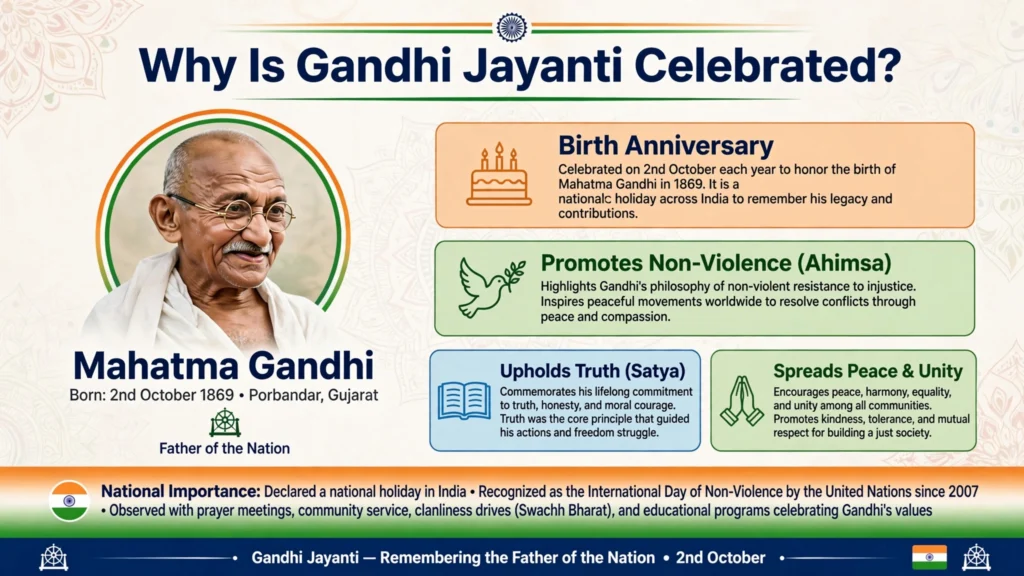
There are several reasons why Gandhi Jayanti remains an important day in India.
Remembering Gandhi’s Life
Gandhi’s life included important experiences in India, England and South Africa before his major role in India’s freedom movement. The Gandhi Heritage Portal chronology records milestones such as his arrival in South Africa in 1893 and the development of Satyagraha in the early twentieth century.
Remembering Non-Violence
Non-violence is one of the ideas most closely associated with Gandhi. The United Nations describes him as a leader of the Indian independence movement and a pioneer of the philosophy and strategy of non-violence. Mahatma Gandhi Jayanti therefore provides an opportunity to understand how peaceful action became part of his public work.
Learning From History
History becomes more meaningful when people connect it with lessons for everyday life. The day can encourage students to read about India’s freedom movement, understand different historical events and think about how values influence individual and social behaviour.
The History Behind Mahatma Gandhi Jayanti
Gandhi was born on 2 October 1869 in Porbandar. Later, he studied law in England and worked in South Africa, where he became involved in issues affecting the Indian community. His experiences there contributed to the development of methods of organised non-violent action.
After returning to India, Gandhi became an important figure in the freedom movement. His public work included campaigns based on non-violent resistance and civil disobedience. The Salt March of 1930 is one well-known example of this approach. The United Nations also identifies the Salt March as part of Gandhi’s use of civil disobedience against British law.
Important Values Associated With Mahatma Gandhi
Gandhi Jayanti is often used to discuss values that can be applied beyond historical study.
Non-Violence
Non-violence means seeking change without using physical violence. Gandhi used this principle as part of his approach to public action. It remains an important subject for understanding peaceful movements and conflict resolution.
Truth
Truth was central to Gandhi’s thinking and public life. For students, this value can be connected with honesty in studies, work and relationships.
Self-Discipline
Social change can also involve personal habits and responsibility. The occasion can be a useful reminder that discipline begins with everyday choices.
Peaceful Action
Peaceful action does not mean avoiding difficult issues. It can involve dialogue, cooperation, protest without violence and efforts to solve disagreements through peaceful methods.
Mahatma Gandhi Jayanti and the International Day of Non-Violence
The importance of 2 October extends beyond India. The United Nations observes 2 October as the International Day of Non-Violence because it is Gandhi’s birthday. The UN General Assembly established the international observance in 2007 to spread the message of non-violence through education and public awareness.
This connection gives Mahatma Gandhi Jayanti a wider international context. It shows how a date associated with an Indian historical figure is also used globally to discuss peace, tolerance, understanding and non-violent action.
How Is Gandhi Jayanti Observed?
Gandhi Jayanti can be observed in different ways by schools, communities and institutions.
Prayer Meetings
Prayer meetings and remembrance programmes are held at places connected with Gandhi and at other institutions. These programmes often focus on reflection and peace.
Educational Programmes
Schools and colleges may organise speeches, essays, quizzes, discussions and presentations about Gandhi’s life and the freedom movement. Such activities help students explore history in a simple and engaging way.
Cleanliness Activities
Clean surroundings and personal responsibility are often discussed during Gandhi Jayanti programmes. Schools and organisations may conduct cleanliness drives and awareness activities.
Public Tributes
People pay tribute at memorials and participate in public events to remember Gandhi. These activities keep historical memory connected with the present.
Why Is Mahatma Gandhi Jayanti Important Today?
The occasion remains relevant because it creates a space to discuss values as well as history. In daily life, people face disagreements at home, school, work and in society. Learning about peaceful communication and responsible action can help students understand how conflicts can be approached without unnecessary hostility.
The day also encourages young people to study history carefully. Instead of remembering only dates and names, students can explore the causes, events and consequences of the freedom movement. This makes learning more meaningful.
At the same time, the day can be understood as a day of remembrance rather than a reason to simplify a complex historical period. Gandhi’s life, ideas and political activities can be studied through historical records and different perspectives.
7 Things Students Can Learn From Mahatma Gandhi Jayanti
Learn the difference between disagreement and violence.
Understand why truth and honesty matter in daily life.
Read history from reliable sources.
Practise discipline in small everyday tasks.
Use respectful communication during disagreements.
Take responsibility for personal and community actions.
Learn how peaceful movements have influenced history.
Mahatma Gandhi Jayanti: A Day to Remember and Learn
Gandhi Jayanti is more than a date on the calendar. It is an opportunity to remember Gandhi’s birth, study his role in India’s history and understand the ideas associated with his public life.
For students, the day can become a starting point for learning about India’s freedom movement and the broader idea of non-violence. For communities, it can encourage reflection, education and peaceful participation.
Conclusion
Gandhi Jayanti, observed on 2 October, connects Indian history with discussions about truth, non-violence, peace and responsibility. Gandhi’s birth in Porbandar in 1869 and his later public work made him an important figure in the history of India’s independence movement.
The United Nations’ International Day of Non-Violence also gives 2 October an international dimension. By studying the history behind the day and understanding its values, people can remember the past while thinking about peaceful and responsible action in the present.